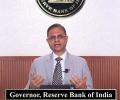
'India has the potential to grow at more than 7%, with the monetary policy providing a supportive hand.'

Concerned over the rise in mis-selling of products by banks and non-banking financial companies (NBFCs), the Reserve Bank of India (RBI) is examining whether to come up with norms to curb such practices. Observing that pushing financial products, such as insurance, indiscriminately to unaware consumers may be detrimental to their well-being, RBI Deputy Governor M Rajeshwar Rao said, "We are examining whether it necessitates framing of guidelines to address mis-selling of financial products and services by REs (regulated entities)."

'My life has been quite difficult. I felt I could see it in words. I thought if everyone else can write, then I can too.'

The country's per capita income is likely to grow by close to 70 per cent to $4,000 by fiscal 2030 from $2,450 in fiscal 2023, helping it become a middle-income economy with $6-trillion GDP, more than half of which will be coming in from household consumption, says a research report. Per capita income/GDP has risen from $460 in fiscal 2001 to $1,413 in fiscal 2011 and further to $2,150 in fiscal 2021. The biggest growth driver will be external trade which may nearly double to $2.1 trillion by 2030 from $1.2 trillion in fiscal 2023 when the GDP printed in at $3.5 trillion, Standard Chartered Bank said in a weekend report which assumes a 10 per cent nominal GDP growth annually from now on.
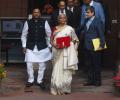
Finance Minister Nirmala Sitharaman on Saturday unveiled 'transformative' tax reforms that ranged from a simpler income tax law to higher TCS threshold for remittances and income tax benefits for middle class.

Tata Power Renewable Energy Ltd (TPREL) has partnered with Bank of Baroda to offer financing for residential rooftop solar projects under the PM - Surya Ghar Muft Bijli Yojana. The partnership aims to make clean energy solutions accessible to households across India. Customers can avail loans up to Rs 6 lakh at an interest rate starting at 7 per cent per annum. The scheme offers flexible repayment tenures and requires a margin contribution of 10-20 per cent depending on the installation size.

Real estate developers are hoping that the slew of tax concessions announced in Union Budget 2025, set to take effect this financial year, will spur demand for affordable and mid-segment housing, even as the broader housing market shows signs of fatigue.

Tenants should primarily buy contents insurance. 'This covers personal belongings like electronics, furniture, clothes, and appliances against risks such as fire, theft, floods, and other natural calamities.

Ask rediffGURU and tax expert Mihir Tanna your income tax-related questions.

Retail inflation dipped marginally to a nearly six-year low of 3.34 per cent in March due to a decline in prices of vegetables and protein-rich items. The Consumer Price Index (CPI) based inflation was 3.61 per cent in February and 4.85 per cent in March last year.

Following the lacklustre growth numbers in the second quarter (Q2FY25), economists believe the upcoming Union Budget for 2025-26 should focus on reforms that will stimulate consumption, manufacturing and spur employment. India's growth unexpectedly slowed to 5.4 per cent in the second quarter, due to low capital formation, weak consumption, besides adverse weather impact.

'The pain of not having a home is bearable, but the pain of having one -- and not finding peace in it -- is far worse.'

Ask rediffGURU and PF expert Milind Vadjikar your insurance, stocks, mutual fund and personal finance-related questions.
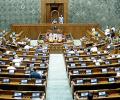
Bharatiya Janata Party on Thursday issued a three-line whip to all of its Lok Sabha MPs asking them to be present in the House for the passing of the Union Budget 2025-26.

Banking on the Budget's tax relief, the BJP seeks to energise Delhi's middle class; the AAP is doing its bit too. But will their outreach mobilise this politically crucial yet disengaged electorate?

Ask rediffGURU and PF expert Milind Vadjikar your insurance, stocks, mutual fund and personal finance-related questions.

The finance minister did very well for equity market investors but not so with families, reveals Mahesh Vyas.

With 56,000 dollar-millionaire households, Maharashtra leads the country in wealth creation followed by Uttar Pradesh, Tamil Nadu, Karnataka and Gujarat, says a report. These states together account for 46 per cent of the 4.12-lakh millionaire households in the country. According to a wealth report by Hurun India, known for its annual rich list, there were 4.12 lakh dollar-millionaire households last year in the country, which has been one of the fastest wealth-creating economies producing the third-most number of billionaires annually.

'Consider your household's financial health and all your other goals.' 'Buying a house might seem like an urgent goal, but it is rarely the only one.'

In Rajasthan, Pilani recorded 44.9 degrees Celsius, Phalodi and Churu touched 43.8 degrees Celsius and 43.5 degrees Celsius respectively, while Bikaner and Jaipur registered 43.4 degrees Celsius and 43 degrees Celsius.

'I am optimistic about the Budget because of the fiscal discipline the government has committed to.'

Something seems to be working for Indian consumers. Yet, the Indian consumer expresses some caution this festive season, reveals Mahesh Vyas.

India's private equity industry is evolving, with local funds securing substantial capital and achieving consistent returns. During a panel discussion at TiEcon Mumbai 2025, industry leaders emphasised growing opportunities in scaling buyouts and expanding domestic investor participation.

S&P Global Ratings on Wednesday said the impact of the US reciprocal tariff will be limited on India as the economy is domestically oriented with less reliance on exports. YeeFarn Phua, Director, Sovereigns and International Public Finance Ratings, Asia-Pacific S&P Global also said India will clock a 6.7-6.8 per cent GDP growth over the next two years.

The interplay between domestic and foreign capital will shape India's equity markets.

With the rapid evolution of channels like quick-commerce and the emergence of ONDC, the Indian retail industry is 'cautiously optimistic' for 2025, in which new-age technologies such as AI and automation will play a crucial role, driving efficiency and personalisation.

Lower income groups earning less than Rs 100,000 a year are yet to recover as are those earning between Rs 100,000 and Rs 200,000.

A special cabinet meeting in Karnataka convened to discuss the contentious Social and Educational Survey report, popularly known as 'caste census', ended without a decision. The cabinet will reconvene on May 2 to discuss the report further and make a final decision.

Once we break free of the idea that land is scarce, real estate is just a pile of bricks, steel, and glass. Any price surge will kick off a supply response, which kills off the possibility of sustained price appreciation, points out Ajay Shah.

In a world where financial literacy is often overlooked, Soha Ali Khan shares the financial wisdom her parents taught her.

Telangana's Rythu Bandhu policy is an embryonic UBI, or rather embryonic QUBI (a quasi-universal basic income, pronounced Kyoo-Bee). And it could potentially also be the future of agricultural policy in India, says Arvind Subramanian.

The number of people averse to the surveys by the National Statistical Office (NSO) has more than doubled over the last five years between the 75th National Sample Survey (NSS) round (July 2017- June 2018) and the 79th NSS round (July 2022-June 2023), the Ministry of Statistics and Programme Implementation MoSPI) said on Friday in a conference organised to discuss the issue of 'non- responsiveness' to its sample surveys. The ministry said that nearly 6.9 per cent people in urban areas surveyed by the NSO for the 79th NSS round did not participate in the exercise, while the number of people in rural India that refused to participate in these surveys stood at 3.9 per cent.

The size of India's middle class will nearly double to 61 per cent of its total population by 2047, from 31 per cent in 2020-21, as continuing political stability and economic reforms with a sustained annual growth rate of between 6 per cent and 7 per cent over the next two and half decades will make the country one of the largest markets in the world. The findings are part of a report released on Wednesday by the People Research on India's Consumer Economy (PRICE) and India's Citizen Environment, a not-for-profit think tank. The report titled, The Rise of India's Middle Class, is based on an analysis of primary data collected by PRICE through its pan-Indian survey.
India will be the world's third-largest economy by 2028 as it becomes the world's most sought-after consumer market and gains share in global output, driven by macro stability influenced policy and better infrastructure, Morgan Stanley said. From a $3.5 trillion economy in 2023, the Indian economy is projected to expand to $4.7 trillion in 2026, which will make it the fourth largest in the world behind the US, China and Germany.
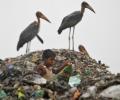
State Bank of India (SBI), in a report on Friday, claimed a significant decline in the headline poverty ratio in rural areas on account of enhanced physical infrastructure, higher consumption growth in the bottom fractile and direct benefit transfers (DBTs).

Consumption of gold is the highest among middle-income households - those with annual income between Rs 2 lakh and Rs 10 lakh - who account for an average of 56 per cent of gold sales over the last five years, according to a nationwide survey conducted by India Gold Policy Centre (IGPC) at the Indian Institute of Management, Ahmedabad (IIM-A). "Per capita consumption is highest among the rich, but total volume still rests with the middle-income group. "With increasing income, there is an increasing propensity to consume gold, although the share of gold in the portfolio does not increase with the same proportion of income," the survey report says.

The AAP chief stressed the need for an increase in healthcare spending, suggesting a rise to 10 percent of the GDP, along with the removal of taxes on health insurance premiums.

'Everyone with a low BMI will not get Type 5 diabetes.'

The risk-reward for the Indian markets, Morgan Stanley said, is turning favourable.
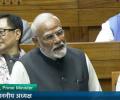
Prime Minister Narendra Modi launched a scathing attack on Leader of Opposition Rahul Gandhi and the Aam Aadmi Party (AAP) in the Lok Sabha on Tuesday, accusing them of "speaking the language of urban naxals" and being "AAP-da" for the youth. He also took a swipe at former Congress chief Rahul Gandhi, saying those who entertain themselves by getting photo sessions done in huts of the poor will find the talk about the poor in Parliament boring. Modi also hailed his government's decisions in the Budget and said that the Ayushman Bharat scheme, which his government started for the poor, has been stalled by some states, leaving poor people in hardship.
 © 2026 Rediff.com - Advertise with us - Disclaimer - Privacy Policy - Sitemap - Feedback - About us - Terms of use - Grievances